Thanks to ongoing work on record reconciliation across photo archives, artresearch.net allows you to compare scholarly images, see changes in artworks over time, explore the histories in artworks, and discover the stories behind photo-objects in one place.
Compare scholarly images and data from different sources
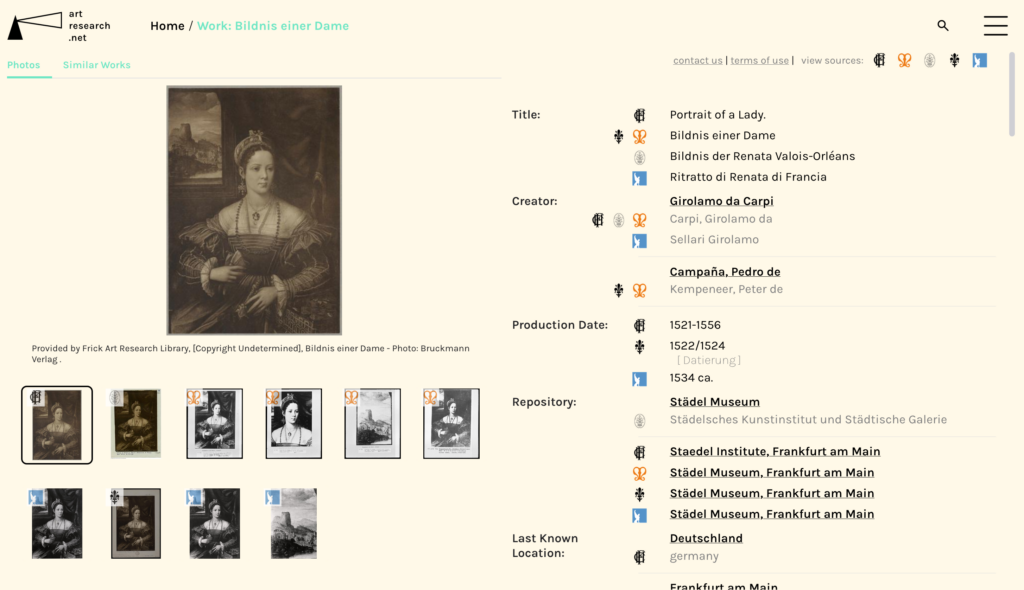
Few Renaissance portraits, such as the one of the lady identified by some as Renata of Valois-Orléans and housed in Frankfurt, have such a controversial history of attribution. Over time, the painting has been referred to artists with vastly different backgrounds, ranging from Girolamo da Carpi to Peter de Kempeneer, from Parmigianino to Nicolò dell’Abate, and from Sebastiano del Piombo to Jan van Scorel. By analyzing the data from various archives—integrated into artresearch.net in a single record—it is possible to reconstruct the historical-critical debate surrounding the work and form a personal opinion on its authorship based on the many photographs collected, taken by photographers using different techniques and at different times. This debate has left a tangible trace on the photographic objects themselves: in the captions of the prints, in the annotations by catalogers and scholars on the backs and on the mounts, as well as in the various classifications the photographs have received within different archival systems.
See changes in artworks over time
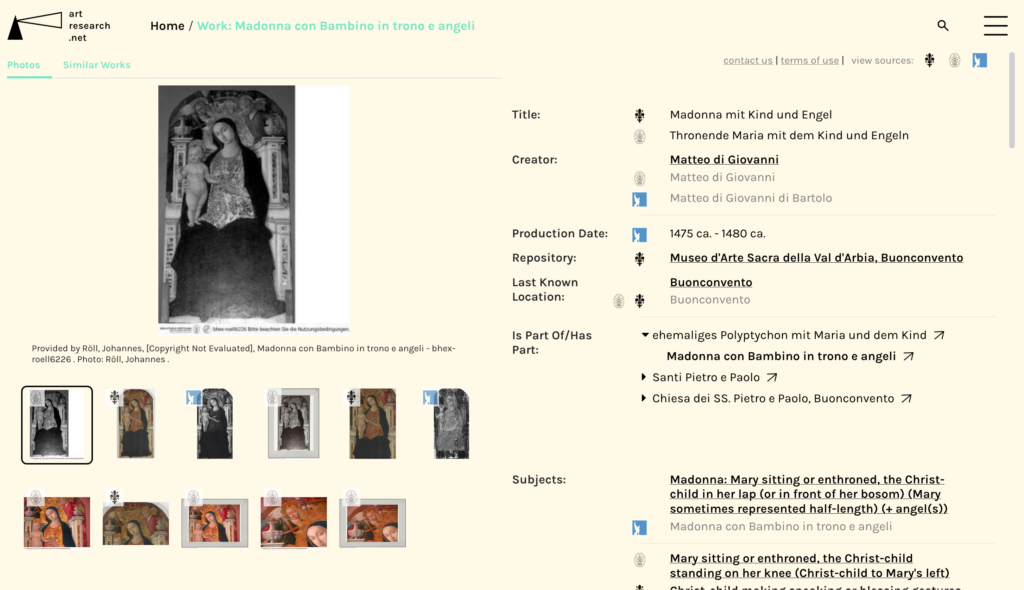
Photographs document the condition of a work of art at a specific moment in time. The panel painting by Matteo di Giovanni from the Pieve of Santi Pietro e Paolo in Buonconvento, near Siena, was subject to several campaigns of overpainting, which dramatically altered the Madonna’s garment. Between 1977 and 1978, the panel received comprehensive conservation treatment. The surface was cleaned and the overpaint removed. Photographs taken by different institutions and photographers record the painting’s condition before and after the restoration, providing valuable visual evidence of changes to its appearance and history.
See histories in artworks

Natural disasters and armed conflicts repeatedly cause severe damage to, or even the destruction or loss of, cultural heritage. Photographic archives preserve numerous traces of such events. For example, during the devastating flood in Florence on 4 November 1966, the Arno overflowed its banks and inundated the historic city center. Cimabue’s painted Crucifix, dating to around 1272 and housed in Santa Croce, was severely damaged. Historical photographs record its condition before the disaster, its rescue and safeguarding in the Limonaia of the Boboli Gardens, and its careful restoration in 1976 at the Opificio delle Pietre Dure. They also document the work’s subsequent reinstallation in the church.
Discover stories behind the photo-objects

The convergence of materials preserved in different photo archives makes it possible to reconstruct not only the history of the subjects depicted, but also that of the campaigns that led to the discovery and “photographic census” of works of art in specific contexts or areas—often the result of collaboration between patrons, photographers, and art historians. This is the case with the campaigns carried out in Italy between 1925 and 1950 by Mario Sansoni on behalf of Helen Frick, with Frederick Mason Perkins acting as intermediary. Sansoni, initially in collaboration with Oreste Nesti, took approximately 10,000 photographs documenting primarily medieval and Renaissance paintings and fresco cycles found in smaller, lesser-known towns—works often not reproduced by commercial photographers.
artresearch.net makes it possible not only to reconstruct the body of images created by Sansoni for the Frick—by locating, for example, prints whose negatives were likely lost during the shipment to New York or over time. It is also possible to compare different photographic items related to the same shots held in various archives: the vintage prints made by the photographer before the expedition, the negatives in the Frick Art Research Library’s possession, and recent reprints provided by the Frick to scholars and institutions upon request. It is therefore possible to identify the retouching the plates underwent once they arrived overseas, appreciate the differences between the various printing techniques, and understand how photographic objects were handled according to the archival practices of various institutions.
Analyze the evolution of iconographic themes over time
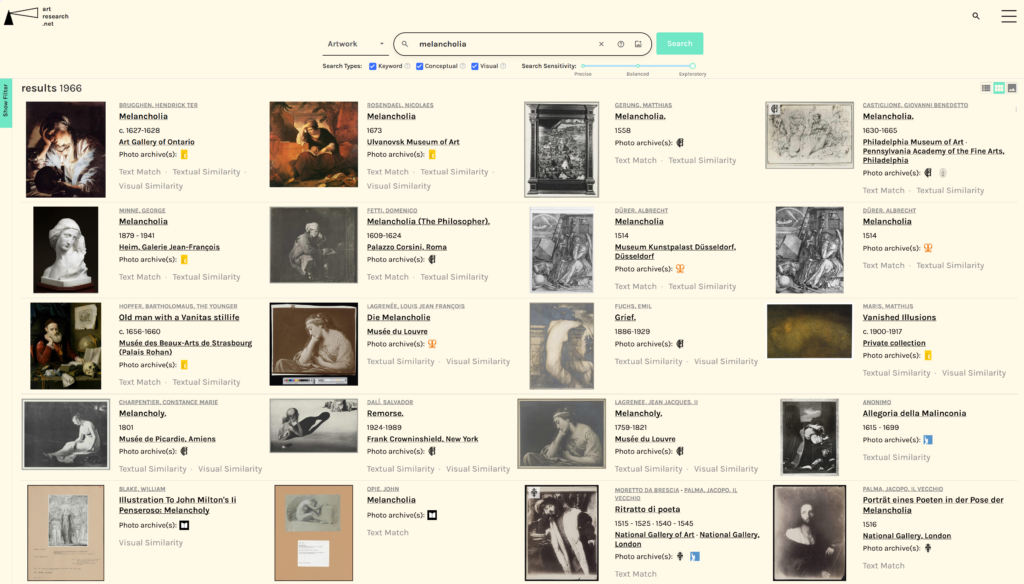
In the history of art, there are themes that have recurred across different eras and geographical regions, linked to universal archetypes, images, or states of mind. Among the most famous is undoubtedly “Melancholia,” whose iconography has been established and made famous over time by artists of the caliber of Dürer, Munch, and Degas. The artresearch search engine allows users to find not only famous works bearing this title but also paintings, sculptures, and drawings that are visually or conceptually linked to this topos. Vanitas, portraits of afflicted or pensive individuals, figures in mourning or funeral scenes, as well as landscapes or interiors characterized by a suspended or somewhat somber atmosphere: among these, one can identify recurring stylistic elements or, conversely, deviations from tradition and the personal interpretations of individual artists.
Explore the ‘photographic history’ of a monument
BAALBEK TEMPLE, LEBANON

Photographs can provide a visual history of monuments whose appearance has changed through excavation, restoration, reconstruction, deterioration, or war damage. The Temple of Baalbek, in Lebanon, offers a compelling example. Photographs by Félix Bonfils, a French photographer working in the Middle East (KHI), document the ruins before the major archaeological campaigns of the early twentieth century, including the German mission of 1898–1905. Compared with photographs made during and after these interventions, these early views provide evidence of the transformation of the monument and its surroundings. Bringing together photographs made at different dates, by different photographers, and preserved in different archives can thus help reconstruct the history of the site, from excavation and reconstruction to later conservation, as documented, for example, by photographs of the restoration of the monument in 1935 in Marburg. The photograph archive thus becomes a visual chronology of the monument, providing a resource for archaeologists, architectural historians, conservators, and heritage specialists, while continuing to attest to the changing interpretations of the site.
Explore cases with a complex provenance and attribution history
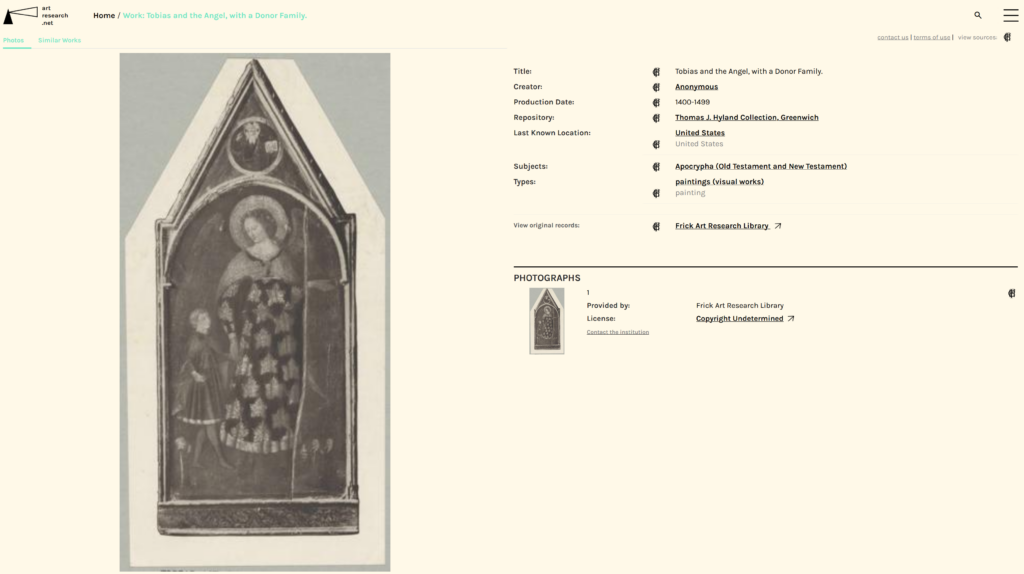
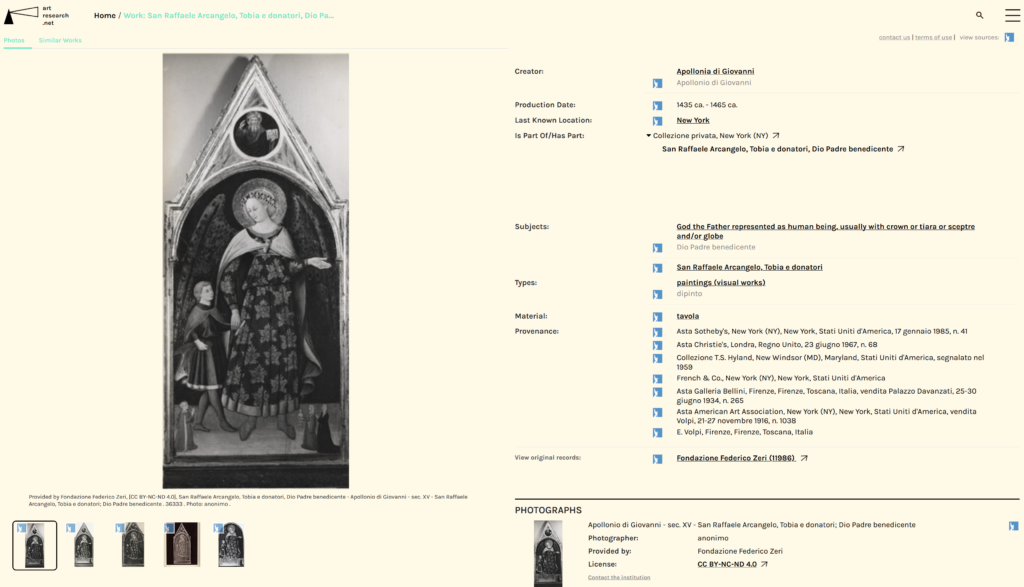
Photographic archives can provide valuable evidence for reconstructing artworks with complex provenance and attribution histories. Tobias and the Archangel Raphael with a Donor Family (15th century) illustrates this potential. Photographs preserved at the Frick Art Research Library, and the Fondazione Zeri record different moments in the painting’s history and document successive attributions, from Anonimo Fiorentino del XV secolo (Frick) to Bicci di Lorenzo (Berenson) and Apollonio di Giovanni (Zeri). Together, the photographic records also trace the painting’s movement through private collections and the art market, including G. K. Stetson (1916), the Palazzo Davanzati auction (Florence, 1934), Galleria Bellini (Florence, 25–30 June 1934), French & Co. (New York), Thomas S. Hyland (New Windsor, 1959), and the Sotheby’s auction (New York, 17 January 1985).Comparing photographs across archives thus makes it possible to bring together different layers of provenance and attribution evidence. The photographs document not only how the painting was identified at different moments, but also where it was located, through whose hands it passed, and how its history was recorded. In this way, photographic archives can serve as important sources for reconstructing the complex trajectories of artworks and their changing histories of attribution and ownership.